Brand:
FocusensSensing Component:
TI TMP117 digital ICWorking Temperature:
–50 to 125 °C (silicone cable)Thermal Time:
Hi-Pot:
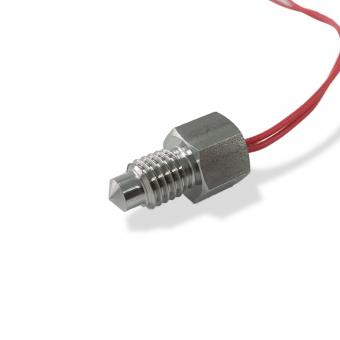
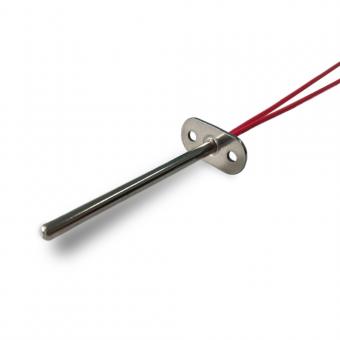
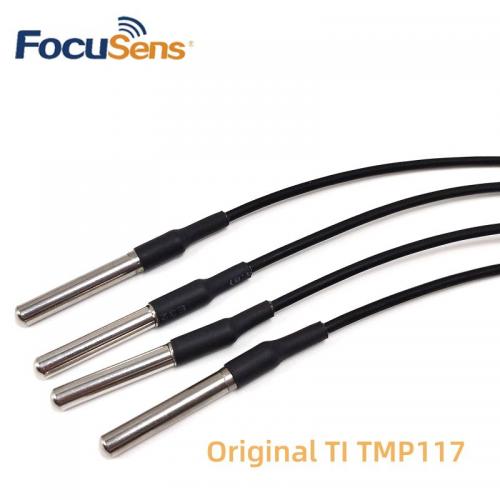
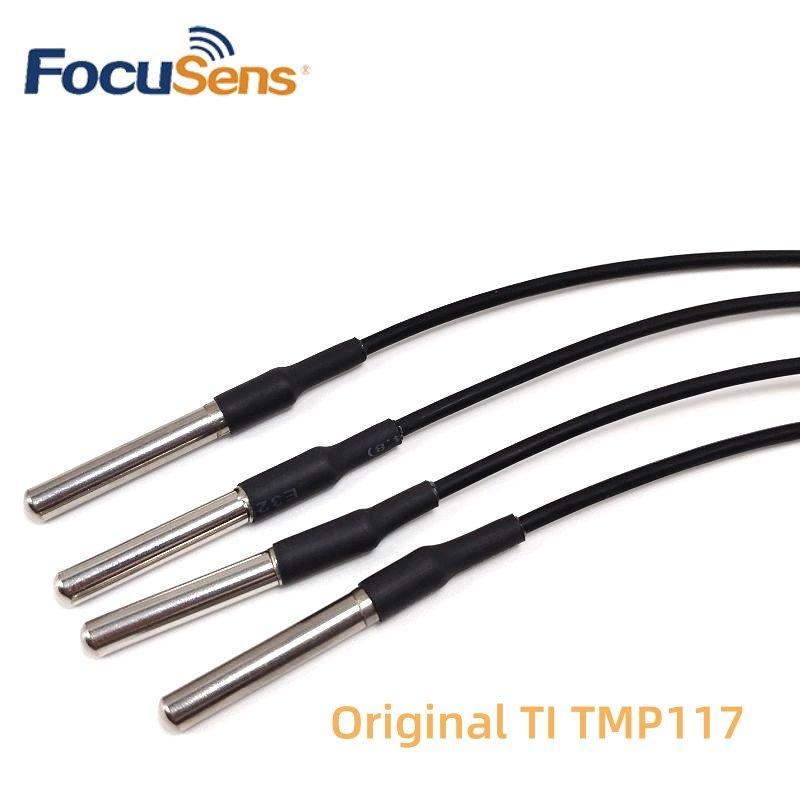
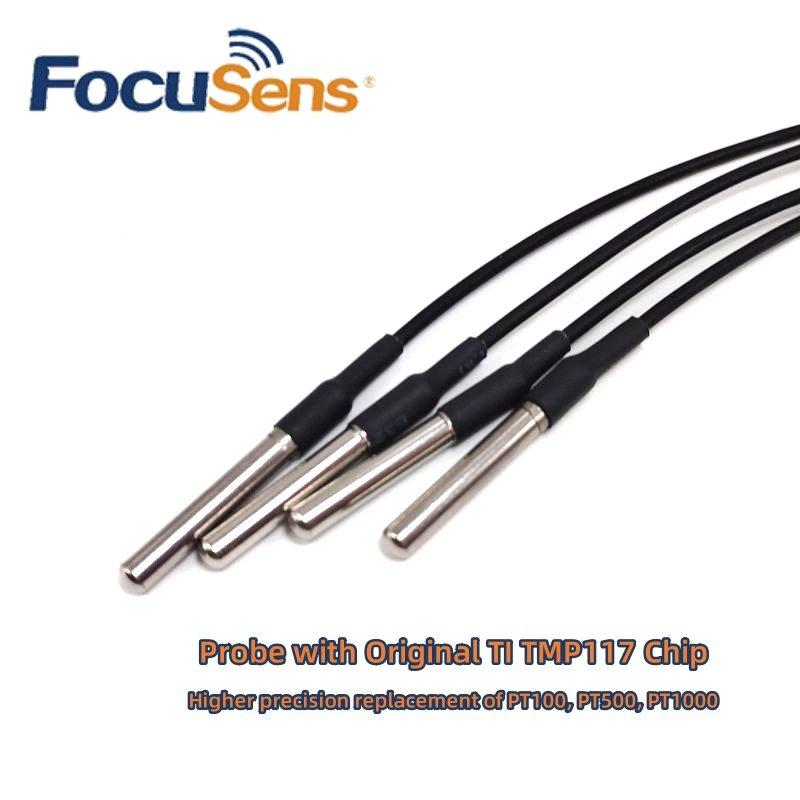
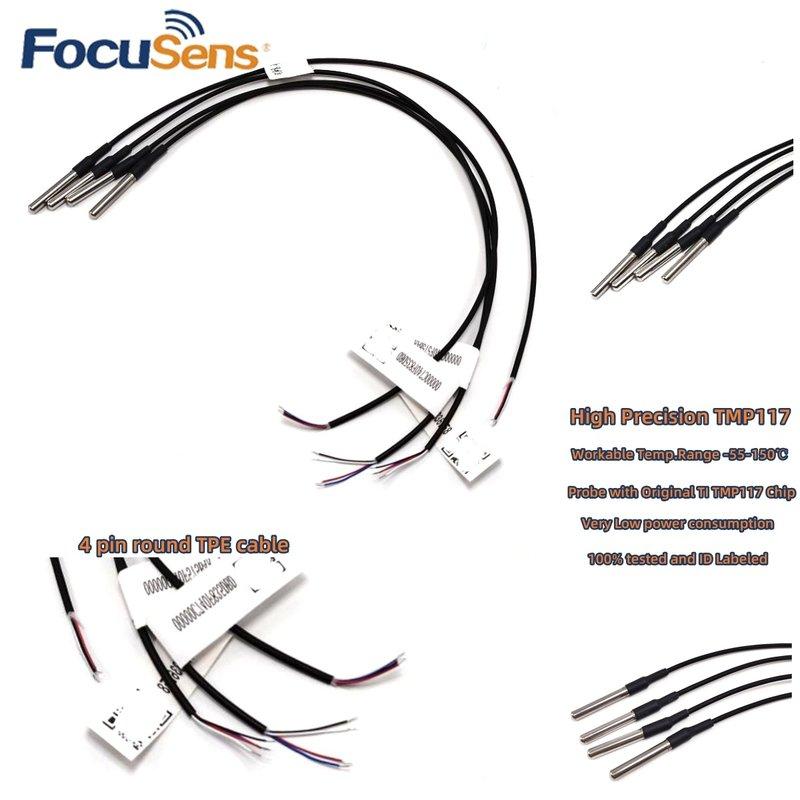
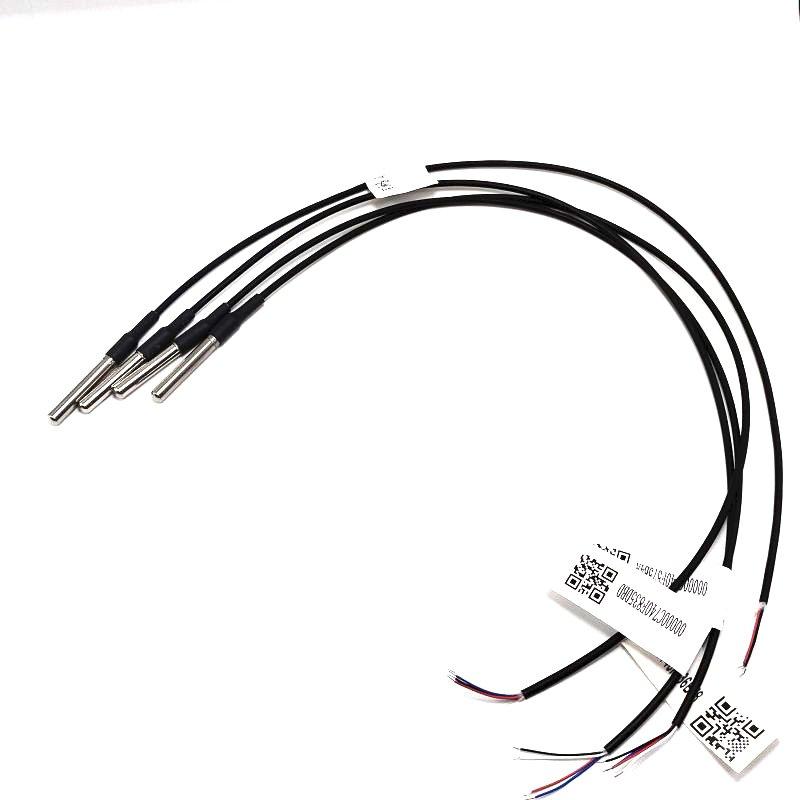
The FST-TMP117 is a sealed digital temperature probe built around the original Texas Instruments TMP117 chip. It reports temperature over I2C with 0.0078 °C resolution. The chip is rated ±0.1 °C maximum from –20 °C to 50 °C. The probe seals it in a SUS304 or SUS316 steel tube rated IP67, on a 4- to 6-wire cable up to 5 m long. Every probe is tested and carries an ID label.
Since 2022 Focusens has supplied TMP117 probes to medical device makers in Western and Northern Europe.
| Item | Value |
|---|---|
| Sensing element | Original Texas Instruments TMP117 |
| Chip accuracy (max) | ±0.1 °C from –20 to 50 °C; ±0.3 °C from –55 to 150 °C |
| Resolution | 16-bit, 0.0078 °C per LSB |
| Supply voltage | 1.8 to 5.5 V |
| Supply current | 3.5 µA at one conversion per second; 150 nA in shutdown |
| Interface | I2C / SMBus; addresses 0x48, 0x49, 0x4A, 0x4B; optional ALERT wire |
| Housing | SUS304 or SUS316 tube, Ø5 × 40 mm or Ø6 × 50 mm; other sizes from Ø5 mm and 40 mm length; sealed with epoxy and double-wall heat-shrink |
| Ingress protection | IP67 standard; IP68 on request |
| Cable | 4, 5 or 6 wires; round PVC, TPE or silicone, or flat 6-core PVC; 0.5, 1, 1.6 or 5 m standard (probe length not included) |
| Connector | Bare tinned leads, M8 male connector, or FPC tail |
| Pull-up resistor | Optional built-in 5.1 kΩ |
| Operating temperature (probe) | –50 to 125 °C with silicone cable; PVC cable builds –20 to 85 °C, –20 to 105 °C or –40 to 105 °C depending on the cable code |
| Traceability | Every probe tested and ID labeled; calibration records per probe or per batch on request |
| Also available with | TMP116, TMP118 or TMP119 |
The ±0.1 °C figure belongs to the TMP117 chip. Once the chip is sealed in a steel tube, three things add to it: the thermal path through the tube wall and epoxy, heat conducted along the tube and cable from the surroundings, and the uncertainty of whatever reference you compare against. In air or in a fast-changing liquid the probe also reads more slowly than a bare chip on a board.
Self-heating is small. At 3.3 V and one conversion per second the chip averages about 3.5 µA, roughly 12 µW (our calculation).
The chip itself works from –55 to 150 °C. The probe is rated –50 to 125 °C because the epoxy, heat-shrink and cable set the limit, not the chip.
Focusens offers this probe as a higher-accuracy replacement for a PT100, PT500 or PT1000 where the host can read a digital signal. Between –20 and 50 °C the TMP117 chip is specified at ±0.1 °C maximum. A Class A platinum element alone is allowed ±(0.15 + 0.002|t|) °C under IEC 60751, which is ±0.2 °C at 25 °C, before the transmitter adds its own error.
The TMP117 probe gives a digital I2C reading. It replaces the RTD and its transmitter or ADC together, so the host needs an I2C input instead of a resistance input.
FST – TMP117 – (3) cable – (4) length – (5) housing – (6) pull-up – (7) wiring and address
| Position | Code | Meaning |
|---|---|---|
| (3) Cable | PR | PVC with jacket, –20 to 85 °C |
| HPR | PVC with jacket, –20 to 105 °C | |
| CPR | PVC with jacket, –40 to 105 °C | |
| S | Silicone with jacket, –60 to 200 °C (probe still limited to 125 °C) | |
| C | Other cable types | |
| (4) Length | 501 / 102 / 162 / 502 | 0.5 m / 1 m / 1.6 m / 5 m, probe length not included |
| (5) Housing | 1540 / 1650 | SUS304 Ø5 × 40 mm / SUS304 Ø6 × 50 mm |
| 2540 / 2650 | SUS316 Ø5 × 40 mm / SUS316 Ø6 × 50 mm | |
| (6) Pull-up | 0 / 1 | No pull-up / built-in 5.1 kΩ pull-up |
| (7) Wiring and address | — | 4, 5 or 6 wires and the I2C address; see Wiring below. Tell us the wiring you need and we will give you the full code. |
Example from the Focusens datasheet: FST-TMP117-CPR-162-1650-1-5A is a probe with –40 to 105 °C PVC cable, 1.6 m long, in a SUS304 Ø6 × 50 mm tube, with a built-in 5.1 kΩ pull-up, 5 wires including ALERT, at I2C address 0x4A.
| Wiring | Wires | Address |
|---|---|---|
| 4-wire | V+, GND, SDA, SCL | Fixed at 0x48, 0x49, 0x4A or 0x4B when ordered |
| 5-wire | V+, GND, SDA, SCL, ALERT | Fixed at 0x48, 0x49, 0x4A or 0x4B when ordered |
| 6-wire | V+, GND, SDA, SCL, ALERT, ADD0 | Set by your board through the ADD0 wire |
Wire colors on the 6-core silicone cable
| Color | Signal |
|---|---|
| Red | V+ |
| White | GND |
| Blue | SDA |
| Black | SCL |
| Green | ALERT |
| Brown | ADD0 |
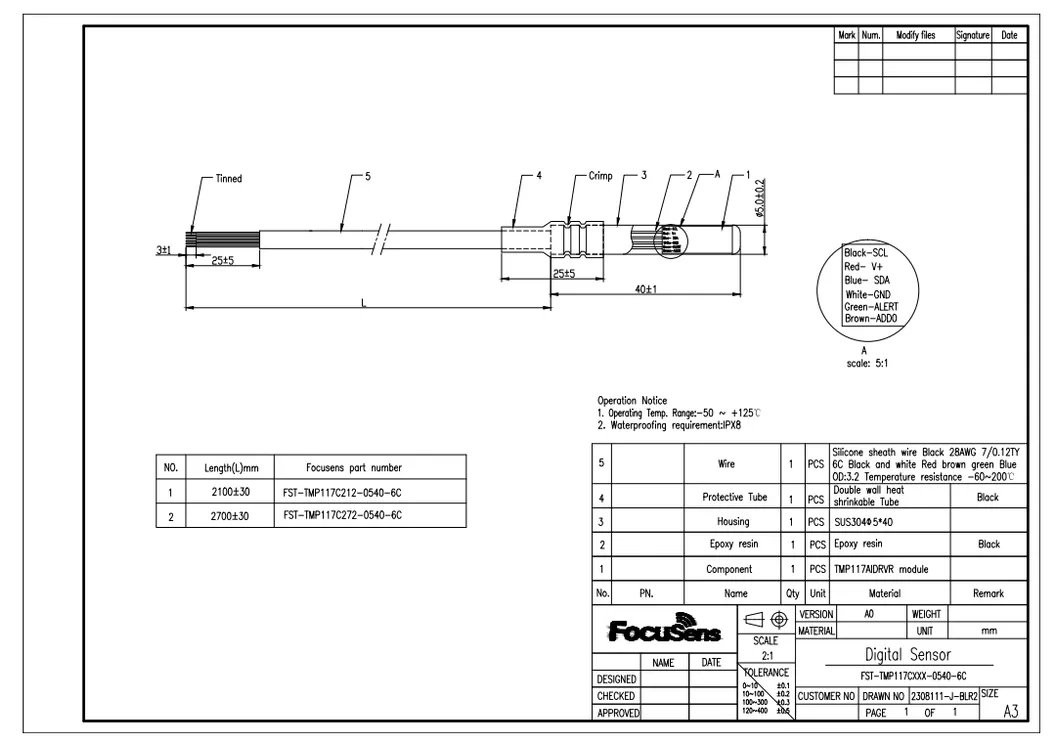
Dimension drawing and wire colors of a TMP117 probe with 6-core silicone cable.
On this cable black is SCL and white is GND. Check the colors before you power up. Other cable types can use different colors, so check the drawing that comes with your order.
Up to four probes can share one I2C bus, one per address.
We normally keep the I2C cable within 5 m. Every meter of cable adds capacitance, and standard I2C allows up to 400 pF per bus (NXP UM10204). If you need a longer run, tell us the length and the host you use before ordering.
The two most common causes we see:
If readings still look wrong, send us the ordering code, cable length and host board, and our engineers will help find the cause.
At the chip level, yes. TMP117 is rated ±0.1 °C maximum from –20 to 50 °C. DS18B20 is rated ±0.5 °C from –10 to 85 °C (Analog Devices datasheet). In a sealed probe both numbers grow with the housing and installation.
Yes. The chip itself is a small surface-mount part, so it needs a sealed housing. This probe seals it in a SUS304 or SUS316 tube with epoxy, rated IP67, and IP68 is available on request.
The chip works from –55 to 150 °C. With silicone cable the probe is rated –50 to 125 °C. With PVC cable the cable sets a lower limit, from 85 °C to 105 °C depending on the type.
Standard lengths go up to 5 m, and we normally keep I2C runs within 5 m. Longer runs need a lower clock rate or a bus extender.
Texas Instruments tests every TMP117 on a NIST-traceable production setup. Focusens tests and ID-labels every probe, and can supply calibration records per probe or per batch on request.
Texas Instruments states that the TMP117 chip meets ASTM E1112 and ISO 80601-2-56. That statement covers the chip. The assembled probe needs its own testing in your device.
Yes. TMP119 is pin-compatible with TMP117 and rated ±0.08 °C maximum from 0 to 45 °C. TMP118 is a smaller, lower-power option rated –40 to 125 °C. TMP116 is the earlier generation, rated ±0.2 °C maximum from –10 to 85 °C.


No.1 XiSan Road, Electromechanical Industry Park , High&New Tech.Zone. Hefei,Anhui,China
Tel : +86-551-69109668
Whatsapp : +86-13339100504
Email : info@focusens.com
Skype : melodyliu520






 +86-551-69109668