PT1000 vs PT100: Which RTD Sensor is Right for You
Nov 16, 2024Updated October 19, 2026. Reviewed by the Focusens Engineering Team.
| PT100 | PT1000 | |
|---|---|---|
| Resistance at 0 °C | 100.00 Ω | 1000.00 Ω |
| Resistance at 100 °C | 138.51 Ω | 1385.06 Ω |
| Slope at 0 °C | 0.391 Ω/°C | 3.91 Ω/°C |
| Tolerance classes (IEC 60751) | Same, in °C | Same, in °C |
| Error from 1 Ω of 2-wire lead at 0 °C | 2.56 °C | 0.256 °C |
| Curve defined over (IEC 60751) | −200 to +850 °C | −200 to +850 °C |
| Class B valid range (IEC 60751 Table 2) | −196 to +600 °C wire-wound, −50 to +500 °C film | −50 to +500 °C (film, the usual PT1000 construction) |
| Element construction | Thin-film or wire-wound | Almost always thin-film |
| Input support | Almost every RTD input | Many, but not all, inputs |
A PT1000 is not a more precise PT100. IEC 60751:2022, the standard for industrial platinum RTDs, defines one resistance curve and scales it by the nominal resistance: the table values "shall be multiplied by the factor R0 / 100 Ω". Its tolerance classes apply "for any value of R0" and are expressed in °C. A Class A PT1000 and a Class A PT100 therefore have the same allowed error, ±(0.15 + 0.002 |t|) °C.
In ohms the tolerance is ten times larger on a PT1000, which matters when you check parts at incoming inspection:
| Class | Tolerance at 0 °C | PT100 | PT1000 | Tolerance at 100 °C | PT100 | PT1000 |
|---|---|---|---|---|---|---|
| AA | ±0.10 °C | ±0.039 Ω | ±0.39 Ω | ±0.27 °C | ±0.10 Ω | ±1.02 Ω |
| A | ±0.15 °C | ±0.059 Ω | ±0.59 Ω | ±0.35 °C | ±0.13 Ω | ±1.33 Ω |
| B | ±0.30 °C | ±0.117 Ω | ±1.17 Ω | ±0.80 °C | ±0.30 Ω | ±3.03 Ω |
Our calculation: IEC 60751 tolerance formulas times the slope at each temperature.
WIKA, a German instrument maker, says the same about the rest of the behavior: "Linearity of the characteristic curve, operating temperature range, and response time are the same for both" (WIKA blog). Neither curve is linear. The slope of a PT100 falls from 0.391 Ω/°C at 0 °C to 0.379 Ω/°C at 100 °C, and a PT1000 falls in exactly the same proportion, so both need the IEC equation or a table rather than a straight line. The full tables are in our PT100 resistance table and PT1000 resistance table.
A PT1000 wins wherever lead resistance is not canceled, which in practice means 2-wire connections. In a 2-wire circuit the instrument reads the element plus both leads, and every ohm of cable reads as extra temperature: 2.56 °C per ohm on a PT100 and 0.256 °C per ohm on a PT1000 at 0 °C. On real cable that looks like this:
| 2-wire cable at 0 °C | Loop resistance | PT100 reads high by | PT1000 reads high by |
|---|---|---|---|
| 10 m of 24 AWG | 1.68 Ω | 4.3 °C | 0.43 °C |
| 30 m of 24 AWG | 5.05 Ω | 12.9 °C | 1.29 °C |
| 10 m of 0.5 mm² | 0.78 Ω | 2.0 °C | 0.20 °C |
| 30 m of 0.5 mm² | 2.34 Ω | 6.0 °C | 0.60 °C |
| 10 m of 0.22 mm² | 1.74 Ω | 4.5 °C | 0.45 °C |
Our calculation from the IEC 60751 slope at 0 °C and copper resistance of 84.2 Ω/km for 24 AWG (HyperPhysics wire table), 39.0 Ω/km for 0.5 mm² (EN 60228 values, Bayka) and 87 Ω/km maximum for 0.22 mm² cable (LiY 0.22 mm² data sheet, TRU Components). The loop is twice the cable length.
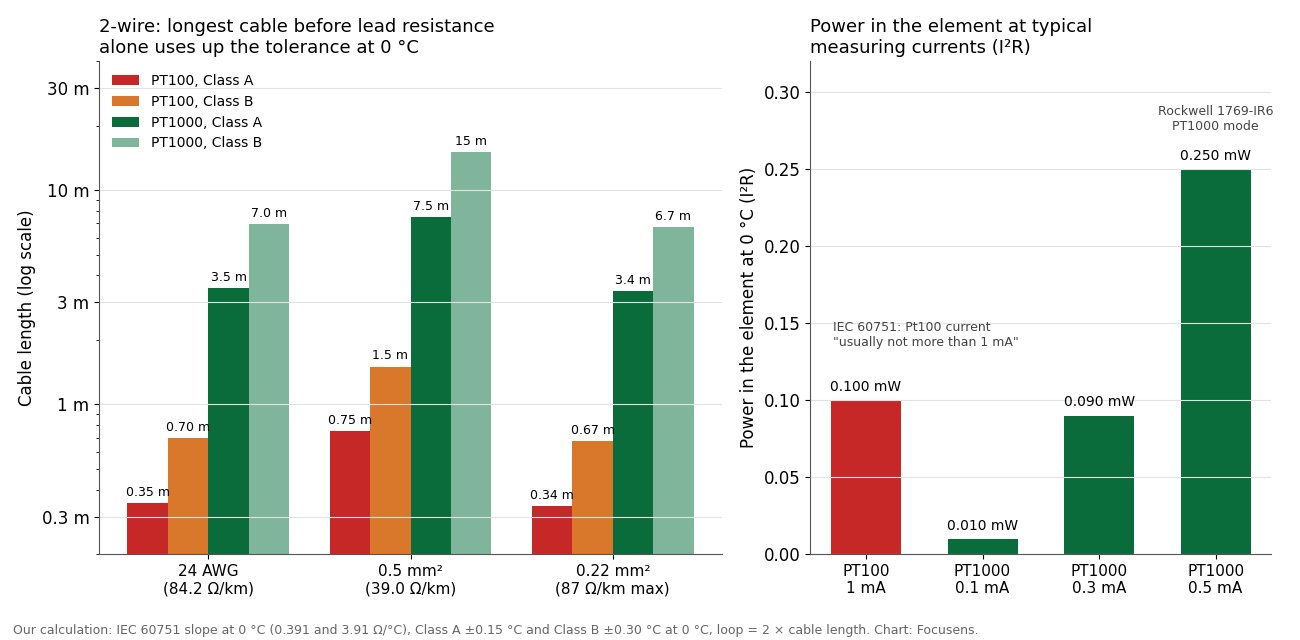
Ten meters of 24 AWG still add 0.43 °C to a 2-wire PT1000, more than the whole Class B tolerance at 0 °C, and IEC 60751 closes the question for Class A: "Thermometers of tolerance class better than class B shall have 3-wire or 4-wire configuration with 4-wire configuration being recommended." Uncorrected, the lead error of a 2-wire PT1000 alone reaches the whole Class B tolerance at 0 °C (±0.30 °C) at about 7 m of 24 AWG or 15 m of 0.5 mm², and the element's own tolerance comes on top of that. On longer runs, measure the loop resistance at commissioning and enter it as an offset, or add a third wire. The chart shows how short the cable has to be before the lead error alone uses up the tolerance.
Cable temperature adds a second 2-wire error that a one-time offset cannot remove. Copper resistance rises about 0.39 %/°C, so 30 m of 24 AWG warming from 20 to 40 °C adds about 1.0 °C to a 2-wire PT100 reading and 0.1 °C to a PT1000 (our calculation, copper coefficient from the HyperPhysics resistivity table).
With 3-wire or 4-wire connections the advantage mostly disappears, because the instrument measures and removes the lead resistance. WIKA notes: "Both types of sensors work well in 3- and 4-wire configurations." How each connection is wired is in our RTD wiring guide for 2, 3 and 4 wires, and the 3-wire imbalance error is worked through in RTD lead resistance error.
The common claim that a PT1000 self-heats less is true only if it runs at less than about a third of the PT100's current. Self-heating is driven by the power in the element, I²R, and a PT1000 has ten times the resistance. At the same current it dissipates ten times the power of a PT100, and at half the current it still dissipates 2.5 times as much (our calculation).
Element makers do recommend lower currents for PT1000s. YAGEO Nexensos gives "Pt100 Ω: 0.3 to 1.0 mA" and "Pt1000 Ω: 0.1 to 0.3 mA (self-heating has to be considered)" (Nexensos TH series data sheet), IST AG lists 1 mA for 100 Ω and 0.3 mA for 1000 Ω as typical measuring currents (IST P1K0.1206 data sheet), and IEC 60751 says the current "is usually not more than 1 mA for a 100 Ω wire wound platinum resistor". At those currents:
| Element and current | Power at 0 °C | Signal per °C |
|---|---|---|
| PT100 at 1 mA | 0.100 mW | 0.39 mV/°C |
| PT1000 at 0.1 mA | 0.010 mW | 0.39 mV/°C |
| PT1000 at 0.3 mA | 0.090 mW | 1.17 mV/°C |
| PT1000 at 0.5 mA (Rockwell 1769-IR6 PT1000 mode) | 0.250 mW | 1.95 mV/°C |
Our calculation, P = I²R at 0 °C.
A PT1000 at 0.1 mA self-heats one tenth as much as a PT100 at 1 mA but gives exactly the same signal per degree. At 0.3 mA it heats about the same, 0.090 mW against 0.100 mW, and gives three times the signal. That choice between more signal and less heat is the low-power advantage of a PT1000, and WIKA rates the PT1000 "better for battery-operated applications." It also suits a microcontroller reading a simple divider with its own ADC. From 3.3 V through a 4.7 kΩ resistor at 25 °C, with the ADC referenced to 3.3 V, a PT1000 gives about 1.8 mV/°C, or 0.45 °C per step of a 12-bit ADC, while a PT100 gives 0.26 mV/°C, or 3.1 °C per step. That divider runs the PT1000 at about 0.57 mA, above the 0.1 to 0.3 mA element makers recommend (our calculation, illustrative values).
Small voltage errors follow the same rule. A fixed voltage error, such as a thermoelectric voltage at a terminal or an amplifier offset, is divided by the signal per degree. At 0.1 mA a PT1000 gives the same 0.39 mV/°C as a PT100 at 1 mA and gains nothing; at 0.3 mA, 1 µV of error is 0.0009 °C instead of 0.0026 °C (our calculation). Interference that reaches the cable as a current works the other way, because the same current produces ten times the voltage across a PT1000: at 0.3 mA the error in °C is about 3.3 times that of a PT100 at 1 mA (our calculation). A PT1000 is not less sensitive to electrical noise in general. On long 2-wire cables its real gain is the smaller lead error.
A PT100 is accepted by almost every RTD input; PT1000 support varies by model:
| Input | PT100 | PT1000 | Source |
|---|---|---|---|
| Siemens S7-300 SM331 (6ES7331-7KF02) | Yes | No | Siemens data sheet |
| Siemens S7-1200 G2 SM 1231 RTD (6ES7231-5PD50) | Yes | Yes | Siemens data sheet |
| Beckhoff EL3202 | Yes | Yes | Beckhoff EL3202 |
| Rockwell 1769-IR6 | Yes | Yes, only with 0.5 mA excitation | Rockwell 1769-IR6 docs |
At ordinary process temperatures, fitting the wrong element gives an alarm rather than a slightly wrong reading. A PT1000 at 20 °C reads 1077.9 Ω, above the 390.48 Ω a PT100 reaches at 850 °C, so a PT100 input shows over-range or an open circuit. A PT100 at 20 °C reads 107.8 Ω, below the 185.2 Ω a PT1000 reads at −200 °C, so a PT1000 input shows under-range or a short (our calculation from the IEC 60751 tables). The same happens on a 4-20 mA head transmitter set for PT100: a PT1000 connected to it looks like a broken sensor. Above about 225 °C that changes: a PT100 then reads more than 185.2 Ω, so a PT1000 input can show an in-range but false value with no sensor-fault alarm, about −178 °C for a PT100 at 500 °C (our calculation). On an oven or other hot process, check the input type before power-up instead of relying on a sensor-fault alarm. Check the connection type too: Beckhoff states that on the EL3202 "for the 2-wire connection an external bridge is necessary", meaning a wire jumper across two of its input terminals. Many older systems were built for PT100 only, so when replacing a sensor, match what is already there. On motor drives the same mix-up happens between a PT1000 and a KTY84; see what a drive reads when the sensor type is wrong.
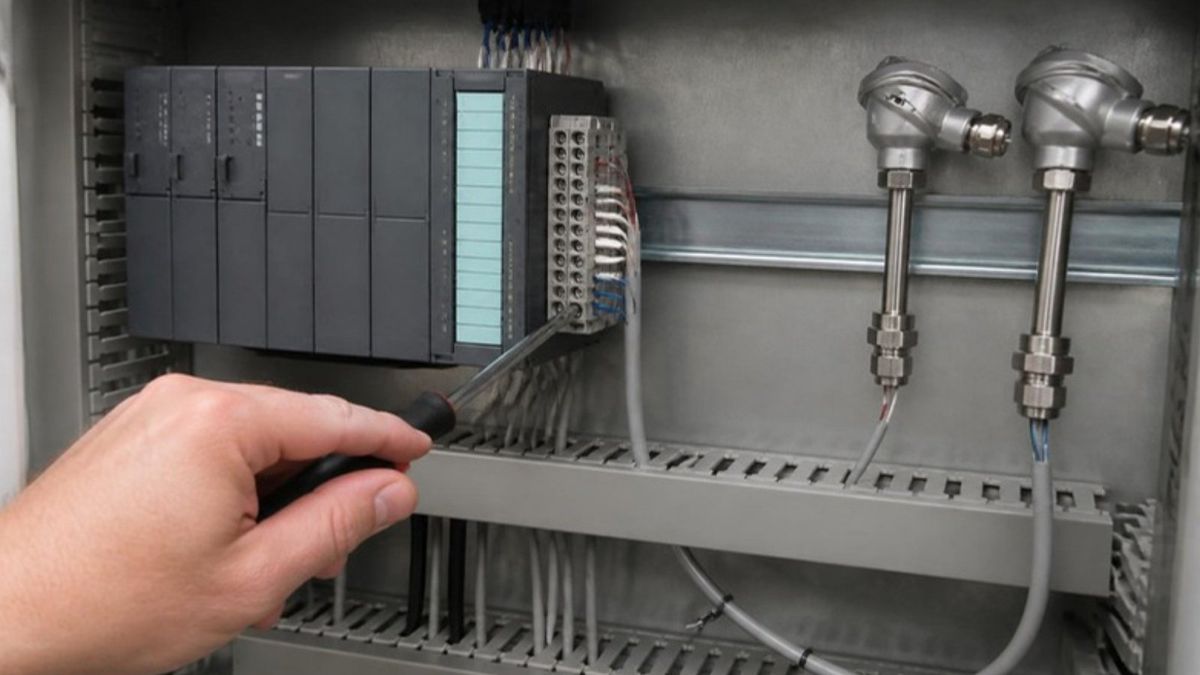
A PT100 is the safer choice in four situations:
WIKA describes the two as "similarly priced". On a 2-wire run the saving is in the cable and terminals, one conductor fewer than a 3-wire PT100.
WIKA puts the overall split this way: "In general, Pt100 temperature sensors are more commonly found in process applications, while Pt1000 sensors are used in refrigeration, heating, ventilation, automotive, and machine building applications" (WIKA text republished by Valin). For a single installation, work down this list:
| Question | Points to |
|---|---|
| What does the transmitter, PLC card or controller accept? | Whatever it accepts. This overrides everything below |
| Does the input drive a fixed 1 mA? | PT100. A PT1000 at 1 mA dissipates 1.0 mW, ten times a PT100 |
| Is the connection 2-wire? | PT1000 |
| Is the cable long or thin, and can you not add a third wire? | PT1000 |
| Is the electronics battery-powered or low-current? | PT1000 |
| Is the loop 3-wire or 4-wire? | Either; PT100 is the default |
| Do you need Class A outside −30 to +300 °C, or a wire-wound element? | PT100 |
| Are you replacing an existing sensor? | The same type as the old one |
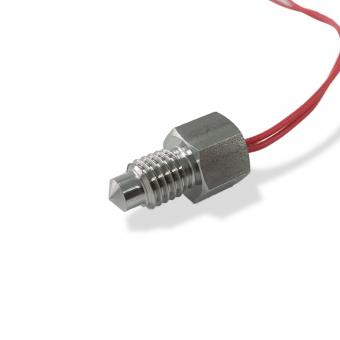
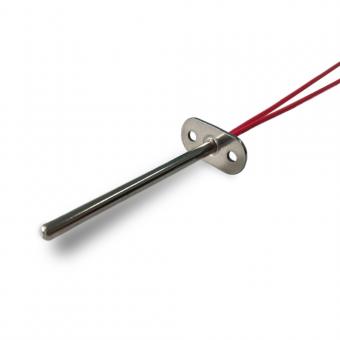
Focusens builds PT100 and PT1000 probes to order in 2-wire, 3-wire and 4-wire versions; see the PT1000 probe, the Class A PT1000 3-wire probe, the PT100/PT1000 3-wire or 4-wire probe and the custom PT100/PT1000 sensor. The product pages in our RTD sensor range list SUS304 or SUS316 housings, Class A or B tolerance, PVC, PTFE (Teflon), silicone or fiberglass cable, and 100 MΩ insulation resistance. When you specify a Class A PT1000, state the temperature range: on a thin-film element, IEC 60751 only allows Class A between −30 and +300 °C.
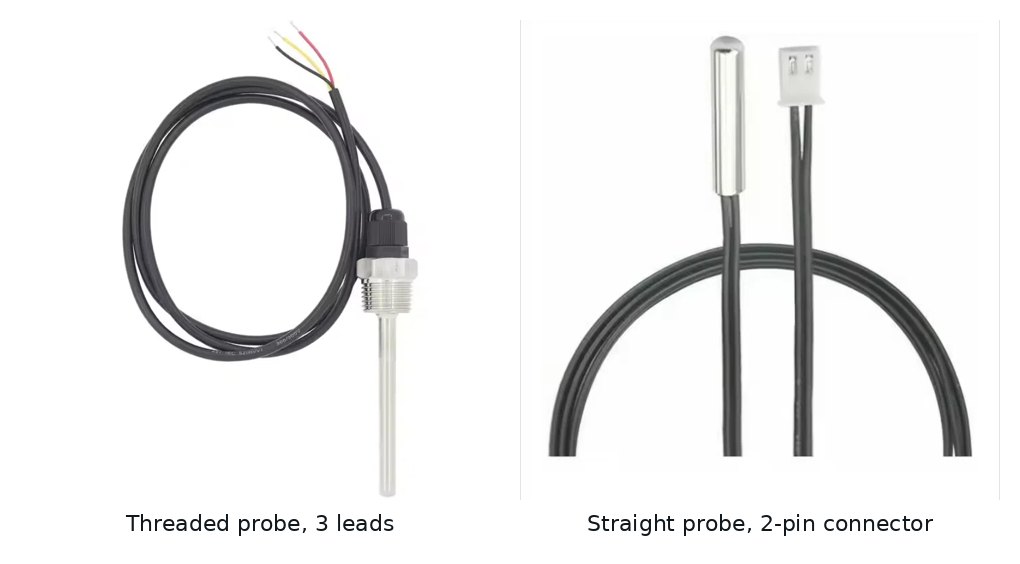
For a quote, send us the element (PT100 or PT1000), class, temperature range, number of wires, cable length and the input it will connect to.
A PT1000 is not more accurate than a PT100. IEC 60751 applies the same tolerance classes in °C to both, so a Class A PT1000 and a Class A PT100 have the same allowed error. A PT1000 gives a more accurate 2-wire measurement only because the same lead resistance causes one tenth of the error.
The advantages of a PT1000 over a PT100 all come from its higher resistance. On a 2-wire connection the same cable causes one tenth of the temperature error, 0.256 °C per ohm against 2.56 °C, and the drift of the cable with ambient temperature shrinks by the same factor. Run at 0.1 to 0.3 mA, it gives the same or a larger signal than a PT100 at 1 mA for the same or less power, which suits battery-powered electronics. It is not more accurate as an element, and it needs an input that accepts PT1000.
A PT1000 is better on 2-wire connections, long thin cables and battery-powered electronics. A PT100 is better when the input only accepts PT100, when you need a wire-wound element or Class A outside −30 to +300 °C, and when the loop is already 3-wire or 4-wire. Both meet the same IEC 60751 tolerance classes.
The difference between a PT100 and a PT1000 is the resistance at 0 °C: 100 Ω against 1000 Ω. Both are platinum RTDs on the same IEC 60751 curve, so every PT1000 value is ten times the PT100 value at the same temperature, for example 138.506 Ω and 1385.06 Ω at 100 °C.
A PT1000 can replace a PT100 only if the input is reconfigured or replaced for PT1000. On a PT100 input, a PT1000 at room temperature reads above the input's range and shows as over-range or an open circuit. Check the transmitter or PLC card first; some, such as the Siemens SM331 7KF02, do not support PT1000 at all.
For a 2-wire connection on a long cable, a PT1000 is better: 30 m of 24 AWG adds about 1.3 °C to a 2-wire PT1000 and about 13 °C to a PT100 (our calculation). IEC 60751 requires a thermometer declared better than Class B to be 3-wire or 4-wire, and either connection removes most of the cable error for both types.
Measure across the element with a multimeter. At 20 to 25 °C a PT100 reads about 107.8 to 109.7 Ω and a PT1000 about 1078 to 1097 Ω. On a 3-wire probe, two leads from the same end read close to 0 Ω, and either of them to the third lead reads the element. Our RTD wiring guide for 2, 3 and 4 wires shows each check.
A PT1000 is an RTD, a resistance temperature detector made of platinum, not a thermistor. Its resistance rises with temperature, so it has a positive temperature coefficient, but it is not a PTC thermistor: its curve is defined by IEC 60751 and changes by about 0.39 % per °C, far less steeply than a thermistor.
A PT1000 does not need 3 wires on a short cable if Class B accuracy is enough, but the cable adds to the element's own error. On 24 AWG the lead error alone reaches the full Class B tolerance at 0 °C (±0.30 °C) at about 7 m of cable (our calculation). A thermometer declared Class A or better must be 3-wire or 4-wire under IEC 60751, whatever its nominal resistance.
Reviewed by the Focusens Engineering Team on October 19, 2026. Curve, tolerance and wiring rules come from IEC 60751:2022; element currents from YAGEO Nexensos and IST AG; input support from the Siemens, Beckhoff and Rockwell documents linked above. Figures marked "our calculation" are computed from those sources and are not bench measurements.
No.1 XiSan Road, Electromechanical Industry Park , High&New Tech.Zone. Hefei,Anhui,China
Tel : +86-551-69109668
Whatsapp : +86-13339100504
Email : info@focusens.com
Skype : melodyliu520






 +86-551-69109668