NTC vs. PTC Thermistors: Key Differences, Applications, and How to Choose
Apr 11, 2026Author: Focusensing Engineering Team | 15+ Years Thermistor Manufacturing Experience
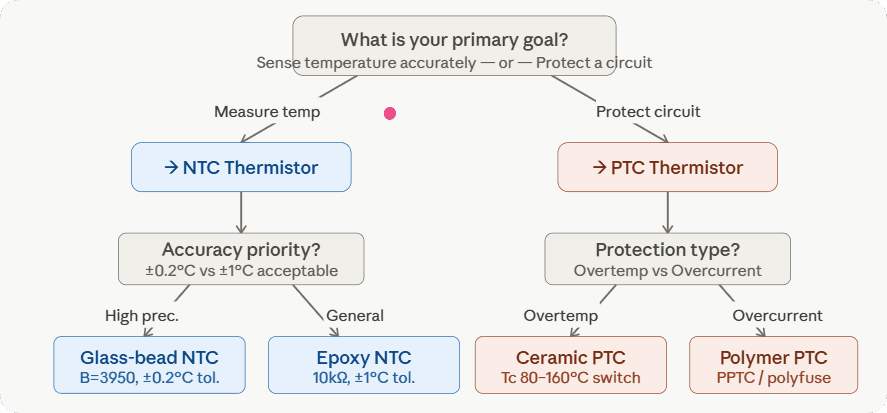
NTC thermistors (Negative Temperature Coefficient) are the correct choice when your goal is to measure temperature with precision — their resistance decreases predictably as temperature rises, enabling ±0.2°C accuracy in BMS, HVAC, medical, and IoT sensing applications. PTC thermistors (Positive Temperature Coefficient) are the correct choice when your goal is to protect a circuit — their resistance spikes sharply at a defined Curie temperature, acting as a self-resetting thermal switch for motor protection, overcurrent limiting, and self-regulating heating. The rule of thumb: if you need to know what the temperature is, use NTC; if you need to stop something from overheating or prevent a current surge, use PTC.
Search for "NTC vs PTC thermistor" and you will find dozens of articles that tell you two things: NTC resistance goes down with temperature; PTC resistance goes up. Then they list some applications and leave you exactly where you started.
That is not a selection guide. That is a glossary entry.
Here is the real engineering problem: most hardware designers already know which direction the resistance goes. What they need to know is which specific scenario calls for which type — and crucially, the cases where the conventional wisdom is backwards. There are several.
This guide is structured around the decision an engineer actually faces at the bench, not around the physics of semiconducting ceramics.
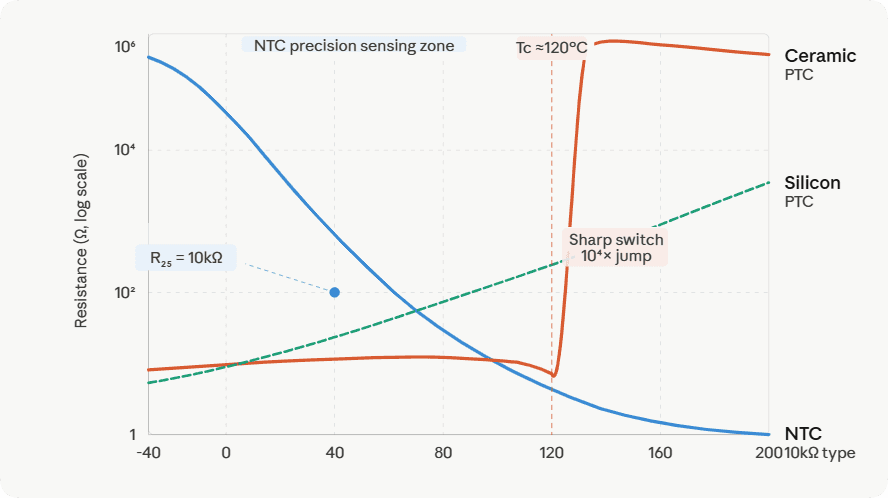
NTC thermistors are manufactured from polycrystalline metal oxide ceramics — typically manganese, nickel, cobalt, or copper oxide compounds sintered at high temperature. At low temperatures, fewer electrons are liberated from atomic positions. As temperature rises, thermal energy frees more charge carriers, dramatically increasing conductivity and reducing resistance. The temperature sensitivity coefficient typically ranges from -3% to -6% per degree Celsius — roughly ten times greater than platinum RTDs and five times higher than silicon temperature sensors. PCBSync
This extraordinary sensitivity is the NTC thermistor's primary engineering advantage. A 10kΩ NTC at 25°C changes by approximately 400–600Ω per degree — a change easily resolved by a simple voltage divider and a microcontroller ADC.
The engineering trade-off nobody talks about: That same sensitivity creates a self-heating problem in precision applications. Self-heating occurs when the thermistor's own sensing current generates enough power to raise its temperature, skewing readings. To mitigate this, use low measurement currents — often less than 10µA for high-resistance types — or select thermistors with higher dissipation constants. Ntcshiheng In a BMS application where you are measuring cell temperature to ±0.2°C, the excitation current through your NTC must be carefully calculated, not left to default.
The B-value problem: The mathematical relationship governing NTC behavior is characterized by the Beta (β or B) constant — typically ranging from 2000K to 5000K, characterizing the thermistor material's temperature sensitivity. Higher B values indicate steeper resistance curves. A commonly encountered value is B=3950K, found in many general-purpose 10kΩ thermistors. For applications requiring accuracy better than ±1°C over wide temperature ranges, the Beta equation's limitations become apparent — the Steinhart-Hart equation provides superior accuracy by achieving ±0.15°C from -50°C to +150°C when properly calibrated. PCBSync
The B-value mismatch is the most common commissioning error in BAS installations — installing a thermistor with B25/85=3950 into a controller programmed for B25/85=3435 introduces a systematic error of up to ±2°C across the measurement range. Focusensing specifies B-value, resistance tolerance, and interchangeability class on every NTC product datasheet for exactly this reason.
This is where most guides fail. They treat "PTC thermistors" as a single category. In reality, there are two fundamentally different PTC thermistor families that share a name but serve entirely different engineering purposes.
Ceramic Switching PTCs (Barium Titanate — BaTiO₃)
Most switching-type PTC thermistors are made from polycrystalline barium titanate. By doping it with specific rare-earth elements, manufacturers introduce donor atoms that turn it into a semiconducting ceramic. The Curie Point is not fixed — by altering the chemical composition, often by adding strontium or lead to the barium titanate base, material scientists can tune the Curie Temperature to precise values. This is why you can get PTCs optimized for motor protection at 100°C or for soldering equipment at 240°C. Ptcntcsensor
The practical behavior: at room temperature, these components have very low, stable resistance. As the device heats up, its resistance can slightly decrease before hitting the Curie temperature, at which point resistance jumps by a factor of 10,000 or more — virtually stopping current flow. The PTC remains latched in the high-resistance state until power is removed and the device cools. PCBSync
Silicon PTCs (Silistors)
Silicon PTCs have a completely different character: their resistance increases gradually and nearly linearly at approximately +0.7% per °C across their entire range. They are used for temperature sensing in power transistors, motor windings, and transformer coil protection — where the sensor must be embedded in the winding itself and provide continuous linear temperature feedback rather than a binary switch action. Amwei
Polymer PTCs (PPTC — Resettable Fuses)
Polymer PTCs are made of conductive particles, such as carbon, scattered in a polymer matrix. Under normal operating conditions, little I²R heat is generated and the conductive particles remain in close contact. When overcurrent occurs, the polymer heats above its transition temperature. The polymer matrix expands, causing the conductive particles to lose contact, which sharply increases device resistance. Passive Components These are the "polyfuses" or PolySwitch devices used on USB ports and battery packs.
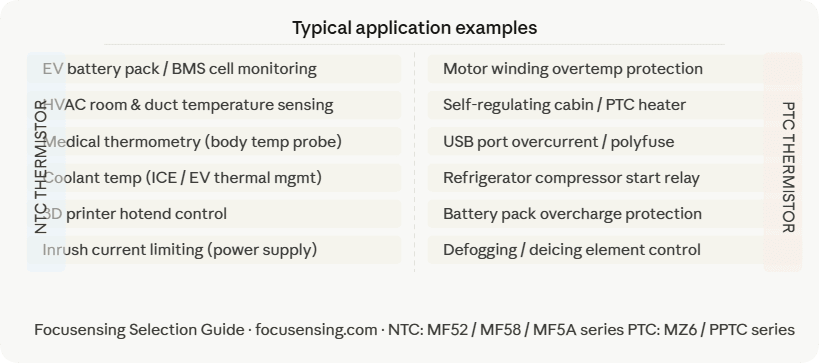
1. EV Battery Pack / BMS Cell Temperature Monitoring This is the NTC thermistor's modern flagship application. Modern batteries are designed to provide high current while maintaining constant voltage. NTC thermistors strategically placed near cells detect hot spots. The thermistor's resistance decreases as temperature rises, allowing the IC's ADC to capture precise temperature readings. Accurate temperature data is crucial for maintaining battery health and ensuring system safety. Newark Electronics
For precise cell monitoring in EVs, procurement teams often require accuracy of ±0.2°C or better. A mid-size EV maker that integrated high-precision NTC thermistors with ±0.2°C tolerance and glass bead encapsulation improved thermal balancing during fast charge events and reduced temperature spread by 18%. Focusensing
Focusensing recommendation: MF58 glass-bead NTC series (B25/85=3950, ±0.2°C interchangeability), 10kΩ or 100kΩ at R₂₅. Use 100kΩ for battery-powered designs — the higher resistance dramatically reduces quiescent current consumption in the voltage divider.
2. HVAC Room Temperature and Duct Temperature Sensing NTC thermistors suit a variety of temperature monitoring and sensing applications. The high sensitivity — resistance changes 3–5% per °C, far more than a platinum RTD at 0.4%/°C — and low cost make them extremely applicable to HVAC and building automation. Zbotic
Standard BAS applications specify 10kΩ Type II or Type III NTC for room temperature sensors. Focusensing's FHT20 wall-mount temperature humidity transmitter uses a digitally calibrated sensing element for HVAC applications requiring combined temperature and humidity output with 4-20mA or 0-10V signals.
3. Medical Body Temperature Measurement Clinical thermometry requires accuracy of ±0.1°C or better. Glass-encapsulated NTC beads in the MF58 series achieve this level of interchangeability. The small bead diameter (1.3–2.2mm) provides fast thermal response critical in clinical probes. Focusensing's FHD4517 medical NTC thermistor achieves ±0.2°C in the 25–45°C physiological range, compatible with YSI-400 monitoring equipment.
4. Engine Coolant and Transmission Oil Temperature (ICE Automotive) Standard automotive coolant temperature sensors use NTC thermistors with AEC-Q200 qualification. Operating range requirement: –40°C to +150°C. Typical specification: 10kΩ at 25°C, B25/85=3435K (matching most automotive ECU lookup tables). Focusensing's MF5A series meets AEC-Q200 requirements for automotive qualification.
5. 3D Printer Hotend Temperature Control In 3D printing, the thermistor monitors and regulates the temperature of the printer's heated elements such as the extruder and heated bed. Precise temperature control is essential for consistent, high-quality prints. By maintaining the optimal conditions necessary for different materials, thermistors ensure reliable printer performance and prevent overheating or printing errors. Focusensing
Standard: 100kΩ NTC at 25°C, B=3950K (the "standard" 3D printer thermistor), replacing the NTC3950 bead in Ender-3 and similar platforms.
6. IoT Environmental Monitoring and Smart Home Devices NTC thermistors interface directly with microcontrollers via a voltage divider — no external amplifier required. A 10kΩ NTC with a 10kΩ fixed resistor and a 3.3V supply gives approximately 1.0–2.3V output across the 0–50°C sensing range — ideal for a 12-bit ADC. Focusensing supplies MF5A epoxy NTC series specifically for IoT and consumer electronics assembly.
Inrush Current Limiting with NTC (Special Use Case) At switch-on, the high resistance of the NTC thermistor appears in series with the smoothing capacitor, limiting the maximum current. The current passing through the thermistor causes it to warm up (self-heating), and its resistance decreases. In this way, the peak inrush current is limited. Avnet
This is a non-obvious NTC application. The same self-heating that creates errors in measurement applications is deliberately exploited here. The NTC starts cold (high resistance, limits inrush), then heats up (low resistance, passes steady-state current with minimal loss). It is passive, cheap, and requires zero control circuitry.
Limitation to know: When a system is quickly turned off and then on again, the NTC thermistor may not have completely cooled. If the NTC thermistor has not had sufficient time to cool, it will have a lower resistance when the system is turned on again, reducing its ability to handle the inrush current. Ametherm For equipment that power-cycles frequently, a PTC or active relay solution is required.
7. Electric Motor Winding Overtemperature Protection This is ceramic PTC's home territory. A PTC thermistor embedded in the motor winding remains in a low-resistance (invisible) state during normal operation. When the winding temperature exceeds the Curie point, resistance jumps by 4–5 orders of magnitude, triggering the motor protection relay to disconnect power. The motor restarts automatically after cooling.
Focusensing's PTC thermistors feature an operating temperature range from 80°C to 170°C, with customizable options from 60°C to 190°C. They are RoHS-compliant and meet IEC 60034-11:2004 and DIN VDE V0898-1-401:2016 standards. Focusensing
Critical specification: Choose a PTC with Tc 10–15°C above the motor's maximum continuous winding temperature to avoid nuisance tripping. Focusensing's MZ6 series offers standard protection temperatures from 80°C to 170°C in single, dual (duplex), triple, and sextuple configurations — critical for three-phase motor protection where all phases must be monitored simultaneously.
8. Self-Regulating PTC Ceramic Heaters (Cabin Heating, Defogging, Deicing) This application exploits the ceramic PTC's inherent power self-regulation. When the temperature exceeds the Curie point, the thermistor almost blocks the current, effectively preventing overheating and ensuring equipment safety. The self-regulating principle means the device automatically limits its own power consumption — it cannot overheat or catch fire even if airflow is blocked. Cnlinkwell
This is one of the strongest arguments for PTC heaters in safety-critical applications: the protection is intrinsic to the component physics, not dependent on an external controller or firmware.
9. USB Port Overcurrent Protection (Polymer PPTC) Polymer PTCs are the workhorses of low-voltage DC circuit protection. Brands like Littelfuse (PolySwitch) made these famous. They have extremely low resistance in the 'on' state but are strictly for overcurrent protection. They degrade slightly every time they trip. PCBSync
For USB ports on consumer electronics PCBs, select a PPTC (polymer PTC / polyfuse) with a hold current 10–15% above maximum normal current and a trip current below the level that would damage downstream components. Do not use ceramic PTCs here — their higher operating resistance causes unacceptable voltage drops at USB current levels.
10. Refrigerator Compressor Start Relay (PTC Motor Starter) Refrigerator compressors require high starting torque, which means high inrush current. A ceramic PTC in series with the start winding provides high resistance during run (effectively disconnecting the start winding after startup) without the mechanical contacts of a traditional relay. This application has been standard in domestic refrigerators for decades.
11. Battery Pack Overcharge / Overcurrent Protection PTC thermistors find application in battery packs to protect against overcharging and over-discharging by controlling the charging and discharging currents based on temperature changes. Ufine Battery
For this application, polymer PTCs (PPTCs) are preferred over ceramic PTCs because of their lower steady-state resistance — critical in high-current battery discharge applications where even milliohms of additional resistance matter.
12. Inrush Current Limiting Where Fast Reset Is Required (PTC vs NTC trade-off) When reset time needs to be near-zero — for equipment that switches on and off frequently, such as welding gear or a plasma cutter — NTC-based limiting fails because the NTC thermistor may not have completely cooled before the next power-on cycle. A PTC thermistor provides effective inrush current protection in these scenarios because its behavior is based on current sensing rather than thermal mass accumulation. Vishay
Contrarian insight #1: "NTC is always cheaper than PTC" — False in total system cost
A ceramic PTC motor protection thermistor costs $0.10–0.50 per unit. The alternative — a bimetallic thermal overload relay — costs $5–50 and requires external wiring, a panel enclosure, and periodic mechanical maintenance. The PTC is installed directly in the motor winding during manufacture, adds zero panel space, and requires zero field maintenance. The true cost comparison is not component-to-component.
Contrarian insight #2: "For precision measurement, always use RTD over NTC" — Not for short-range applications
In most cases, NTC thermistors rather than PTC thermistors are used in precision temperature measurement applications. In terms of temperature range, the RTD curve is near linear, and the sensor covers a much wider temperature range — commonly –200°C to +850°C — than thermistors due to their nonlinear characteristics. Analog Devices
However, for applications within –10°C to +85°C (BMS, body temperature, food safety, HVAC comfort control), a high-grade NTC with Steinhart-Hart calibration achieves ±0.1°C accuracy — matching Class A PT100 RTDs at one-tenth the component cost and with far simpler interface circuitry. The RTD's linearity advantage is irrelevant if you are not using the linear portion of its range.
Contrarian insight #3: "PTC thermistors can measure temperature" — Misleading
Ceramic PTCs have a small negative temperature region below their Curie point. Some engineers attempt to use this region for temperature measurement. The resistance-to-temperature curve of a PTC thermistor exhibits a very small NTC region until its switching point (or Curie point) is reached. The switching point is typically between 60°C and 120°C, which is not suitable for monitoring temperature measurements in a wide range application. Analog Devices
The ceramic PTC's resistance in its pre-Curie region has poor reproducibility between units and poor long-term stability. It is not a precision measurement device — full stop. Silicon PTCs (Silistors) can measure temperature linearly, but their accuracy (±1–3°C) and cost make them unsuitable for applications where an NTC or RTD can be used.
Contrarian insight #4: "NTC and PTC can substitute for each other in inrush limiting"
Both PTC and NTC thermistors offer distinct advantages for managing inrush current. While PTC offers great self-healing properties that can help protect against overloads or short circuits without requiring manual intervention, NTC offers more efficient active monitoring techniques such as soft start circuits or pulse width modulation. Sislercompanies
The deeper truth: NTC for inrush limiting is a passive, one-time-per-power-cycle solution. It works beautifully for equipment that powers on rarely (server racks, industrial machinery). It fails for equipment that cycles frequently. Engineers who specify NTC inrush limiters for cycling loads without checking cooling time constants discover this failure mode in field reliability data, not on the bench.
For samples, custom B-value specification, or technical consultation on thermistor selection for your specific application, contact the Focusensing engineering team directly.
Mistake 1: Ignoring B-value tolerances in production batches Individual thermistor interchangeability (resistance tolerance at R₂₅) is specified. B-value tolerance between production batches often is not — and it matters more. A ±1% R₂₅ tolerance with ±2% B-value tolerance compounds to ±3–4% temperature error at 85°C. For BMS and medical applications, always request B-value lot certification, not just R₂₅ tolerance.
Mistake 2: Using a ceramic PTC for temperature measurement There are a few available PTC thermistors that are used in overcurrent input protection circuits or as resettable fuses for safety applications. During an overcurrent condition, the PTC thermistor will have a high amount of self-heating beyond the switching temperature, and its resistance will increase dramatically. Analog Devices This self-heating makes measurement impossible in the protection zone.
Mistake 3: Paralleling NTC inrush current limiters Paralleling several NTC thermistors is inadmissible, since the load will not be evenly distributed. The thermistor carrying the largest portion of current will heat up until it finally receives the entire current, which may result in destruction of the device, while the other paralleled thermistors remain cold. Mouser Always wire NTC inrush limiters in series, never in parallel.
Mistake 4: Selecting PTC Tc equal to the maximum operating temperature The PTC trips at Tc ± 10–15°C of tolerance. Selecting a PTC with Tc equal to your motor's maximum continuous temperature means nuisance tripping during normal peak operation. Add 10–15°C of headroom: if your motor's Class F insulation is rated at 155°C, specify PTC Tc at 140°C, not 155°C.
Mistake 5: Ignoring NTC measurement current self-heating In precision applications, the current through the thermistor can cause it to heat itself. Ensure your drive current is low enough to make this effect negligible. The Dissipation Constant in the datasheet is key for this calculation. Ptcntcsensor For a 10kΩ NTC with a dissipation constant of 1mW/°C, 10µA drive current causes 1µW of self-heating — negligible. But 1mA drive current causes 100µW = 0.1°C systematic error. In a medical thermometer or a BMS measuring to ±0.2°C, this error is significant.
Choose NTC when:
Choose Ceramic PTC when:
Choose Polymer PTC (PPTC) when:
Choose Silicon PTC (Silistor) when:
Q: Can I use the same NTC thermistor for both temperature sensing and inrush current limiting? No. NTC thermistors optimized for sensing have small beads, low thermal mass, and low dissipation constants — they are destroyed by the currents used in inrush limiting applications. Power NTC thermistors for inrush limiting are large disc formats with high current ratings. The two product families are not interchangeable.
Q: What is the maximum temperature an NTC thermistor can measure? The maximum temperature NTC thermistors can measure is less than 130°C for standard epoxy-coated types. Sensor Tips Glass-encapsulated types (like Focusensing MF58 series) extend this to 250°C. For applications above 150°C, an RTD or thermocouple is typically more appropriate.
Q: How do I identify an NTC vs PTC thermistor if there is no marking? Measure the resistance at room temperature, then gently heat the thermistor using a heat source and measure resistance again. If resistance drops as temperature rises, you have an NTC thermistor. If resistance increases, it is a PTC thermistor. Focusensing
Q: Does a PTC thermistor wear out after it trips? Ceramic PTCs are generally rated for thousands of trip cycles without significant degradation. Polymer PTCs degrade slightly with each trip — their hold current specification decreases over time. For applications where the PTC trips frequently, plan for periodic replacement and specify a polymer PTC with margin above the actual hold current requirement.
Q: What is the difference between a PPTC polyfuse and a ceramic PTC? Ceramic PTCs are always "active" — even in normal operation, they run slightly warm. They handle high-voltage mains applications (120V/240V). Polymer PTCs have extremely low resistance in the 'on' state and are strictly for low-voltage DC overcurrent protection. They degrade slightly every time they trip. PCBSync Ceramic PTCs for mains voltage; polymer PTCs for DC logic and battery circuits.
Q: Can I use an NTC thermistor without the Steinhart-Hart equation? Yes, using a lookup table (LUT). Most BMS ICs and microcontroller firmware libraries implement either Steinhart-Hart or a pre-calculated LUT for standard NTC curves. For B=3950 or B=3435, published lookup tables give temperature from resistance across the full operating range with <0.1°C interpolation error at 1kΩ resolution. Steinhart-Hart coefficients provide better accuracy over wider ranges but require calibration.
Focus Sensing and Control Technology Co., Ltd. (Focusensing) is an ISO 9001:2015 certified, Chinese National Grade Hi-Tech Enterprise headquartered in Hefei, Anhui, China. With over 15 years of thermistor manufacturing experience, Focusensing produces:
NTC Thermistors: MF5A epoxy series, MF52 radial series, MF58 glass-bead series, FHD medical series — standard and custom B-values, resistance tolerances, and packaging for automotive, medical, HVAC, IoT, and industrial applications.
PTC Thermistors: MZ6 ceramic motor protection series (single, dual, triple, sextuple), PPTC resettable fuse series, ceramic PTC heater discs — standard Curie temperatures from 60°C to 180°C.
All products are RoHS and REACH compliant. Automotive-grade products meet AEC-Q200. Motor protection PTC thermistors meet IEC 60034-11:2004 and DIN VDE V0898-1-401:2016.
Why This Article Exists — And What Others Get Wrong
Part 1: The Fundamental Physics — Just Enough to Make Good Decisions
NTC Thermistors: The Measurement Workhorse
PTC Thermistors: Two Completely Different Animals
Part 2: The Comparison Matrix — Everything You Need in One Place
Parameter
NTC Thermistor
Ceramic PTC
Silicon PTC
Polymer PTC (PPTC)
Temp coefficient
–3 to –6%/°C
Very high positive (switch)
+0.7%/°C (linear)
High positive (switch)
Sensing function
Precision measurement
Threshold switch only
Linear measurement
Threshold switch
Typical resistance range
1kΩ – 1MΩ at R₂₅
100Ω–1kΩ (below Tc)
600–2000Ω at R₂₅
0.01–100Ω (hold state)
Accuracy
±0.1–0.5°C (high-grade)
Not applicable
±1–3°C
Not applicable
Response time
< 1s (bead type)
1–10s (bulk ceramic)
1–5s
1–10s
Operating range
–55°C to +150°C
–40°C to +250°C
–55°C to +180°C
–40°C to +125°C
Self-resetting after trip
N/A
Yes (after cooling)
N/A
Yes (after cooling)
Linearity
Non-linear (exponential)
Non-linear (step function)
Near-linear
Non-linear
Cost (typical)
Low–Medium
Medium
Medium
Low–Medium
Typical unit cost
$0.02–$2.00
$0.10–$5.00
$0.20–$3.00
$0.05–$3.00
Primary application
Temperature sensing
Motor/overtemp protection
Linear sensing in windings
USB/battery overcurrent
Material
Metal oxide ceramic
Doped BaTiO₃
Monocrystalline silicon
Conductive polymer
IEC standard
IEC 60539
IEC 60738
—
UL 1434
Part 3: 12 Application Scenarios — Exact Selection Answers
Applications Where You Should Always Choose NTC
Applications Where You Should Always Choose PTC
Part 4: The Contrarian Insights — What Conventional Wisdom Gets Wrong
Part 5: Focusensing Product Mapping — Matching Application to SKU
Application
Focusensing Product
Key Spec
EV battery cell monitoring
MF58A/B glass NTC
10kΩ, B=3950, ±0.2°C, Ø1.3mm bead
High-precision medical probe
FHD4517 medical NTC
±0.2°C in 25–45°C, YSI-400 compatible
General HVAC sensing
MF5A series epoxy NTC
10kΩ/B=3950, –40 to +105°C, fast response
HVAC wall-mount transmitter
FHT20 series
4-20mA/0-10V, ±3%RH, Sensirion SHT21
3D printer hotend
MF52 NTC
100kΩ, B=3950, radial epoxy, compact bead
Automotive coolant sensing
MF5A-3 (AEC-Q200)
10kΩ, B=3435K, sealed, automotive grade
Inrush current limiting
Power NTC disc type
1–47Ω at R₂₅, high I_max rating
Motor winding protection
MZ6 ceramic PTC
Tc 80–170°C, single/dual/triple, IEC 60034-11
Self-regulating heater element
Ceramic PTC heating disc
Custom Tc, 220V/110V rated
PPTC / resettable fuse
PPTC series
0.05–5A hold current, SMD/THT
Part 6: The 5 Engineer Mistakes That Make Everything Worse
Summary: The One-Page Answer
Frequently Asked Questions
About Focusensing — NTC and PTC Thermistor Manufacturer
No.1 XiSan Road, Electromechanical Industry Park , High&New Tech.Zone. Hefei,Anhui,China
Tel : +86-551-69109668
Whatsapp : +86-13339100504
Email : info@focusens.com
Skype : melodyliu520






 +86-551-69109668